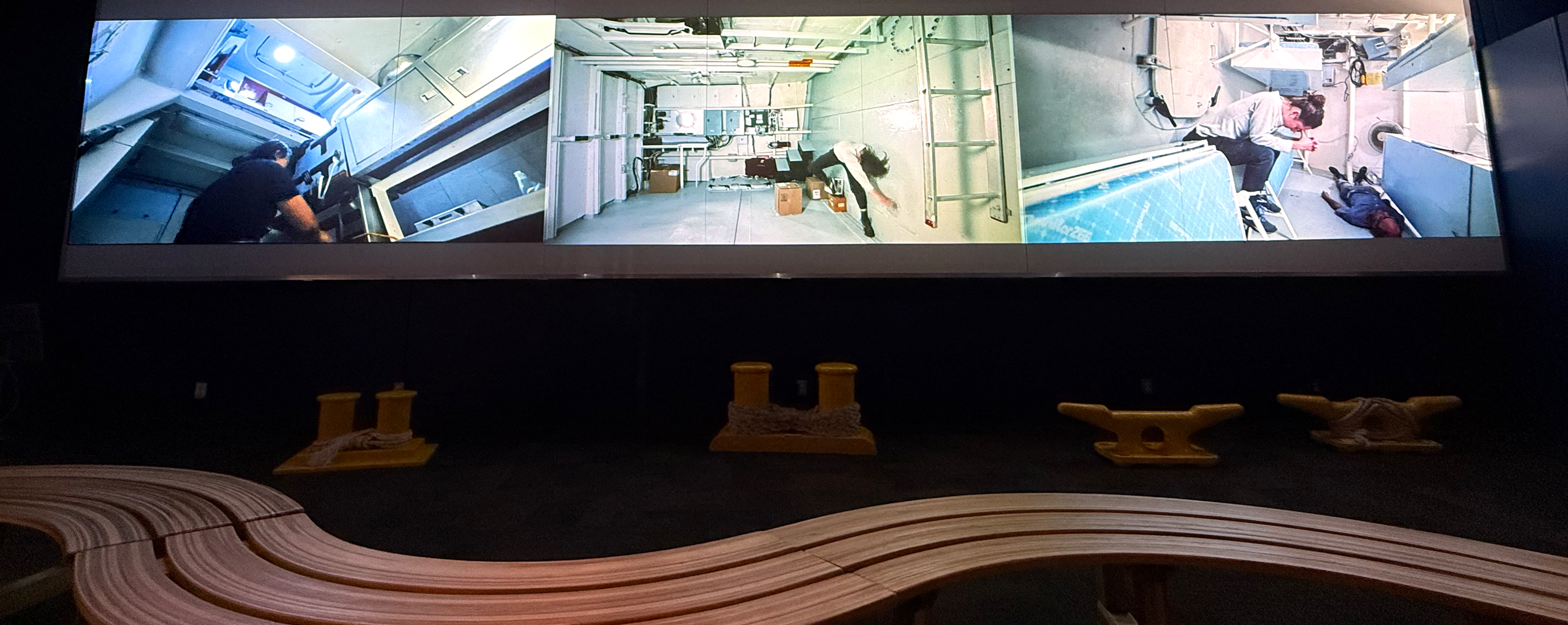
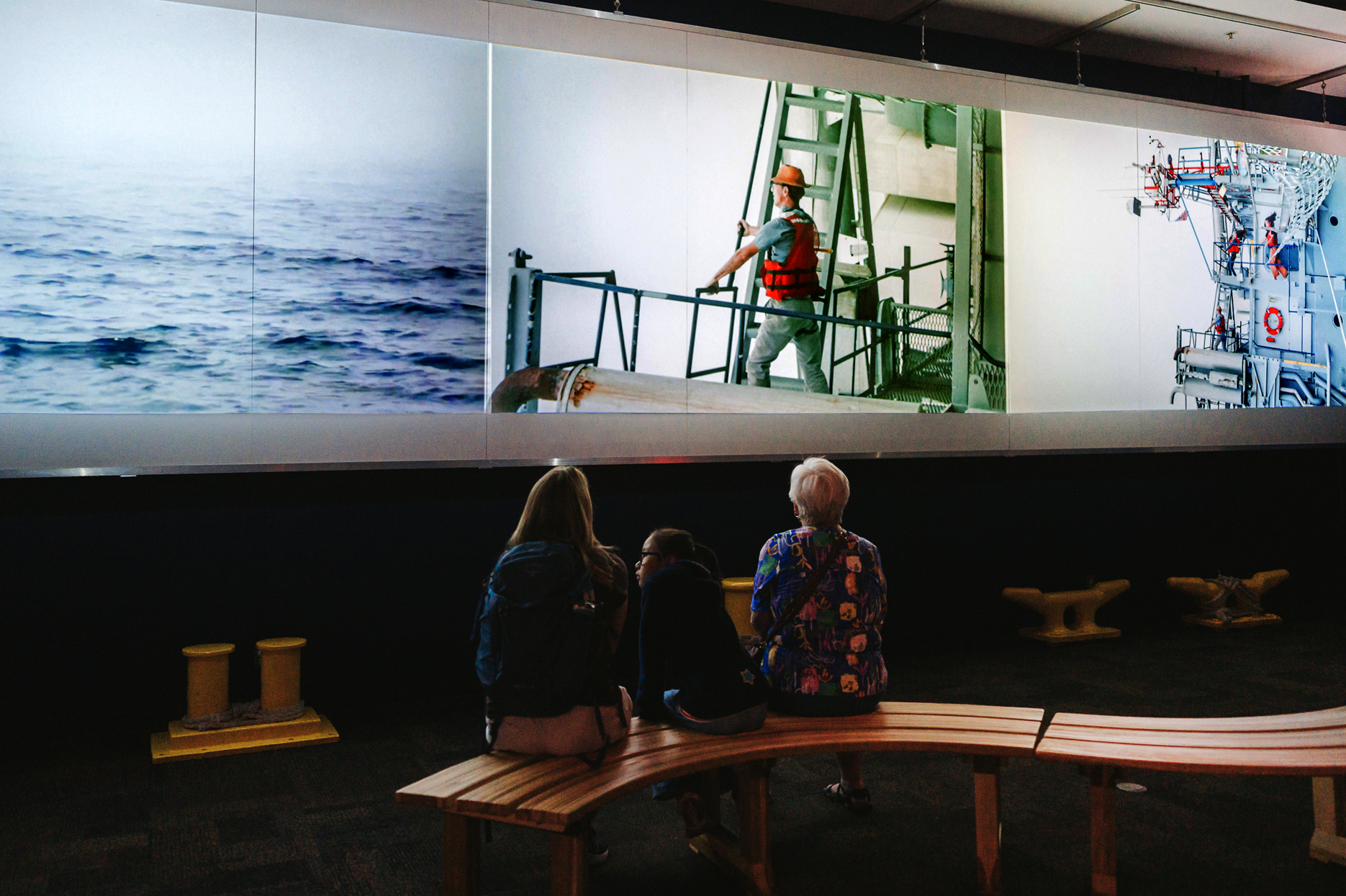
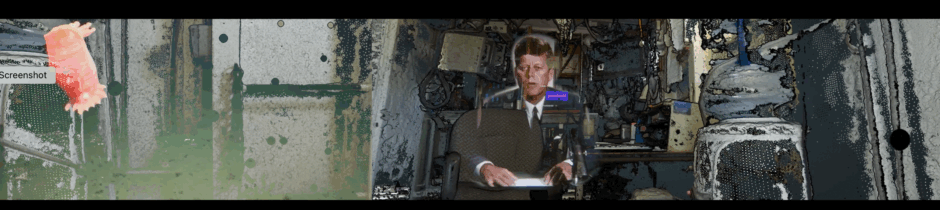
11.5 minute 3 channel video installation at Birch Aquarium at Scripps Institute of Oceanography for Getty’s PST Art 2024: Art & Science Collide, 2024-5.
R/P FLIP R.I.P is an experimental video about the R/P FLIP, which stands for Research Platform FLoating Instrument Platform (1962-2023), the world-famous nautical rarity that flips 90 degrees to become a live-in buoy for studying the ocean. The FLIP was designed for stability to study acoustics in a turbulent ocean, yet ironically the interior is fluid, built for living both in horizontal and vertical orientations. In the artwork, performers activate the FLIP’s architecture as a playground for disorientation: floors become walls, and doors become holes. Intercut with military and oceanographic films, the FLIP film becomes a platform for conceptual flips: landlubbers encountering the alien world of the ocean, and of oceanography’s shift from militarism to ecology. Commissioned for the Getty-sponsored Southern California landmark show PST Art: Art & Science Collide, created by artist Rachel Mayeri, R/P FLIP R.I P. is presented as a three-channel video installation at the Birch Aquarium at Scripps Institute of Oceanography until August 2025.
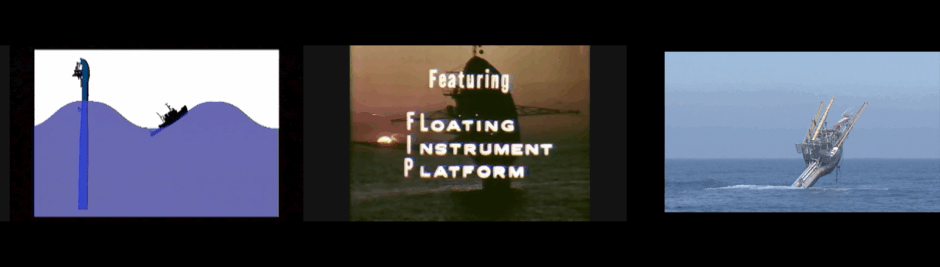
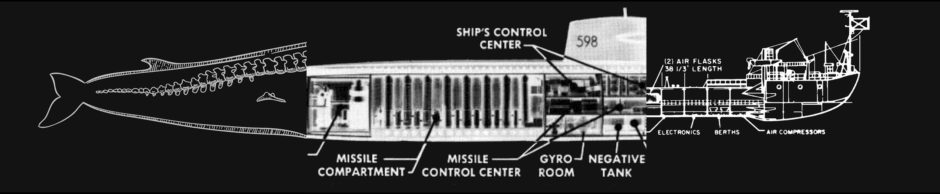
Between the 1960s and 1980s, FLIP’s mission made a dramatic flip from military reconnaissance to environmental crisis. FLIP started out as a platform to support anti-submarine echolocation, but by the 1990s had become a tool for understanding the experience of whales in an ocean under siege by human impacts. The unique interior is a space M.C. Escher might envision — designed for living in both horizontal and vertical orientations, there are sinks at right angles, a stove that swivels, and confusing doors, ladders, and portals. Once docked in Point Loma, California, the FLIP was decommissioned in 2020 and towed away for dismantling in 2023.
The key fascination of the FLIP is that the vessel appears to capsize with people on board. To reenact this spectacle, artist Rachel Mayeri directed actors on the FLIP as if the vessel were flipping — without ever leaving port. With the simple trick of rotating the frame, the actors appear to be gravitating toward the walls as the room or ship rolls. These scenes activate the disorientating architecture of the vessel. They also echo the mental gymnastics we go through to prepare for the cataclysmic events. The narrative is motivated by the actual procedures of crew and scientists working together to outfit the FLIP for a research voyage, loading and securing scientific instruments, choreographing their movements to each other and the logic of the ship.
credits
Performers
TESS COLLINS
ISABELLE KAY
ROBBY HERBST
JUNYI MIN
LUKA SPEAR
Camera
DARREN KAWASAKI
Music
DANIEL WALTER
Sound Design
ADAM PERRISH KING
Color Correction
ALEX JUUTILAINEN
More Camera
Dana Washington-Queen
Paolo Zuniga
LiDAR and Photogrammetry
Scott McAvoy, Digital Media Lab UCSD
Doug Daniels
Brad Perez
Yuzi Chu
Jessica Ashook
Heidi Batchelor
Joe Riley
Production Assistance
Waverly Wang
Periscope Film
Indiana University Libraries Moving Image Archive
Scripps Institute of Oceanography Archives
UCSD Library
Waves Across the Pacific, 1967
FLIP, the Floating Instrument Platform, 1965
Langmuir Cell Department Research Initiative, Nick Statom, 2016
FLIP – Hawaii Op. 69, Phil Rapp, 1969
Copyright Soft Science 2024
A film by
RACHEL MAYERI
Research
RACHEL MAYERI and
DEBORAH FORSTER
Researcher and Crew Interviews
Rob Pinkel
Jules Jaffe
John Hildebrand
Bruce Appelgate
William Gaines
Tom Golfinos
Thanks
Lisa Cartwright
Megan Dickerson
Deborah Forster
Rob Raad
Nan Renner
David Serlin
Amanda Tasse
Made with support from
Hixon-Riggs Center for Responsive Engineering
Harvey Mudd College
Getty PST ART: Art & Science Collide
University of California San Diego
Birch Aquarium at Scripps Institute of Oceanography